
Using Body Language, Proximity, and Touch to Build Unforgettable Characters
The Technique That Reveals Everything


Here is a micro-scene from a novel I’m currently writing:
“I’ll walk you to your car.”
“You don’t have to. It’s right there.”
Juan followed her anyway, and when they reached her car, he gently touched her fingers as she reached to open the car door.
“Hey, Rachel. You looked a little sad. I thought you might want to sit in the lobby, have a coffee, and chat. I wasn’t suggesting anything else.”
Was that touch comforting? Romantic? Or was it something else entirely—controlling, even manipulative?
The answer is: it depends on the characters.
The same touch can mean completely different things depending on what the characters intend and how they react.
The important thing for novelists to remember is that touch is one of the fastest ways to reveal who a character really is.
Why Touch Is a Character Tool
In my world of romance writing and women’s fiction, writers often think of touch as romantic shorthand, but in all fiction, it’s much more powerful. We should think of any type of touch as what it reveals about the characters and the relationship.
Touch and physical proximity reveal everything beneath the surface—emotional openness, boundaries, vulnerability, power, trust, even fear.
Two characters can say the same line of dialogue, but their physical behavior changes the entire meaning. How are they reacting? Think of touch as making the subtext visible.
In the above piece of dialogue, Rachel is moving away from him. She clearly didn’t want to continue the conversation, which means touch would not be welcome.
He touches her anyway, barely. Just her fingers. It could be seen as comforting and kind, or it could suggest controlling behavior.
What matters now isn’t the touch—it’s how she interprets it, and how he responds when she does.
Why Writers Often Miss This Tool
All touches should help you develop your characters, and you should keep that in mind whenever you include them in a scene. Two ways you may miss opportunities are that you avoid touch entirely, meaning your characters speak but never physically interact. The result is a “talking head” effect: voices floating in space with no physical reality.
The second problem is using touch generically (He touched her arm. She hugged him.). This doesn’t ignite a feeling, and the reader can’t interpret what that touch means.
Touch without intention doesn’t develop character, and you want to use touch as a mechanism to show the reader who the character is and what they believe.
When you decide that one character should touch another, ask yourself: Who initiates touch? Who withdraws? Who invades space—and who protects it?
In my scene, Juan initiates touch. He invades her space. I haven’t given you enough context to understand why he does this, but I’ll tell you that he does this because he’s concerned about her. She’s about to get in a car and drive. He’s worried about her mental state. But he realizes that he may have appeared to be “hitting on her” so he wants to stop her and explain. He’s also a cop, so it’s in his nature to be observant and more determined.
Neither Rachel nor the reader really knows all this about him yet, but his actions begin to reveal who he is and his personality.
We are delving into character psychology.
All this from one touch.
You see this as well in The Hunger Games by Suzanne Collins. Early in the story, Katniss Everdeen keeps her distance from others. Touch is dangerous—it creates attachment, and attachment can get you killed.
But when she holds Rue as she’s dying, everything changes. She stays close. She comforts her. She allows that connection.
That touch marks a turning point, not just in the scene, but in Katniss’s character. Compassion overrides survival.
Again, nothing needs to be explained. The physical closeness tells us who she is becoming.
Four Character-Revealing Categories of Touch
It helps to place touch into four categories that allow us to focus on what touch reveals about characters.
1. Defensive Distance
Some characters avoid touch entirely (trauma survivors, highly controlled personalities, characters guarding emotional secrets), for a variety of reasons, and the unwillingness to be touched tells us a great deal about them. It reveals a trauma. When these characters finally allow proximity, it signals major development.

Distance becomes the character’s armor, so when they take steps toward trusting another person enough to allow touch, readers will see growth.
Growth shows up in small, physical shifts—stepping closer, allowing someone into their space, choosing not to pull away.
As you build your scenes, intentionally plan the moments of touch and make them more intimate each time.
2. Power and Control
Touch can establish hierarchy. Who is in control and why? Powerful characters often touch freely, and they may not even realize they are doing it. This again reveals character. It might look simple, for example:
gripping an elbow
guiding someone through a doorway
touching the back of the neck
invading personal space
These are not neutral actions. They define hierarchy. You’ll see this a lot in romance novels. Usually it’s the male character, but not always. When the character is taking control, they tend to move from words to touch. And it can indicate many things about the character. It can be dominance, but it can also be confidence. A character may use touch as manipulation or possessiveness, but it can also be protectiveness. It almost always shows that the character is an authority of some type.
So, if more powerful characters touch more, less powerful characters react rather than initiate contact. When you’re building character dynamics, this is good to understand.
And sometimes, what matters most is the touch that doesn’t happen.
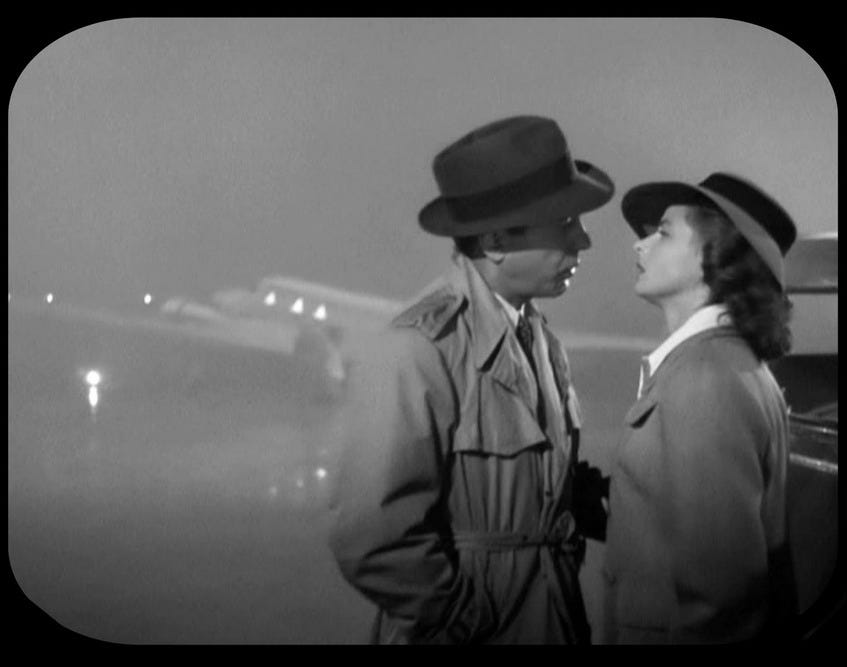
In the classic Casablanca, Rick Blaine and Ilsa Lund stand together in their final scene, deeply in love, but physically restrained. There’s no desperate embrace, no clinging. The distance between them reflects Rick’s decision. His control. His sacrifice.
In this case, restraint is power.
3. Comfort and Safety
Touch can reveal emotional bonds long before characters admit them. Again, in romantic relationships, especially as they are developing, you’ll see characters initiating touch before they admit to having feelings for the other person. The heroine might brush lint off the hero’s shoulder. He might squeeze her hand if she’s revealing something emotional to tell her he understands.
You’ll also see this between friends as they move from acquaintances or work colleagues to actual friends. After a stressful meeting, one may offer a steadying pat on the arm or a quick shoulder touch, or even a hug. This shows concern and that they are comfortable enough with each other to touch. It demonstrates that we are moving into the friend category.
These are care signals. They show affection, emotional connection, and sometimes protectiveness
Often, readers notice these moments instinctively before the characters do. When Nurse A sees a newly hired Nurse B standing outside a patient’s room, trying to hold back tears, and quietly squeezes her shoulder as she passes, we understand what’s happening.
A connection has formed.
4. Intimacy and Vulnerability
The best workshop I ever attended was early in my writing career. It was in San Diego, and a writer I didn’t know at the time gave a presentation on the stages of intimacy. The writer was Linda Howard, and her framework changed how I thought about touch and how I used it in my writing.
You’ve already seen hints of this. When Juan touches Rachel’s fingers, he’s jumped to the fourth step on the intimacy ladder, and the problem is that it was unearned. This type of touching signals trust that Rachel doesn’t have for him yet.
Howard’s famous talk explains that intimacy develops through progressive stages of physical and emotional closeness, such as:
accidental touches
lingering contact
casual closeness
protective gestures
deliberate intimacy
Each step signals growing trust.
Her framework involves twelve steps, and it’s a lot to share in this blog, but I will share a link for you to access and read.
What to remember in this category is that escalating touch mirrors escalating emotional stakes. As characters grow closer in a romantic relationship, touch will increase and become more intimate.
When characters jump over the natural stages of touch, you’ll see problems, even when it’s consensual. Characters may meet, have sex, then feel awkward. Then they typically step back and start again, moving through the expected steps of intimacy until the emotional matches the physical needs.
Track Touch Like Character Growth
Track how your characters touch each other across the story—this is your physical arc. It goes along with character development. It might look like this:
Early story:
Do they avoid contact?
Do they keep physical distance?
Mid story:
Do touches become accidental?
Do they linger?
Do they move through the early stages of intimacy
Late story:
Do they initiate touch intentionally?
Do they seek closeness?
You can use this as a checklist to see if you’ve included growth throughout your novel.
If you are using touch to show character development, you’ll want to keep track of how they are growing and changing.
The Language Readers Feel
Touch is one of the most powerful storytelling tools because it operates below dialogue.
Readers instinctively interpret distance, proximity, gestures, and contact without you having to tell them.
Look at this example:
You can write: He cared about her.
Or you can write: He adjusted the collar of her jacket before she stepped outside.
The gesture, the contact, the action he took, tells us more about what he feels and who he is than the author telling you. We read his caring and protectiveness in what he does.
Touch is never just touch. It’s a character-building tool. It should be used intentionally to tell the reader who the characters are, what they want. what they fear, and to show how their relationships change.
For more writing support, visit: Wise Writer Publishing